Lead acid batteries are used as a power source for vehicles that demand a constant and uninterruptible source of energy. Just about every vehicle today does. For example, street motorcycles need lights that operate when the engine isn’t running. They get it from the battery. Accessories such as clocks and alarms are battery-driven. Starting your vehicle depends on a battery.
Technically speaking, the battery is an electrochemical device that converts chemical energy to electrical energy. The first thing you notice inside a battery is the cells. Each cell has about two volts (actually, 2.12 to 2.2 volts, measured on a DC scale). A 6-volt battery will have three cells. A 12-volt battery, six cells.
Characteristics & Configuration
Characteristic:
Best selected materials, consummate craft together with excellent in quality and reasonable in price;
Adopting PP material to make it endure vibration more strongly;
Be able to endure over charged and discharged.
Easy to be loaded and transported without acid leakage
Features and Benefits
Components
Features
Benefits
Cast Grid
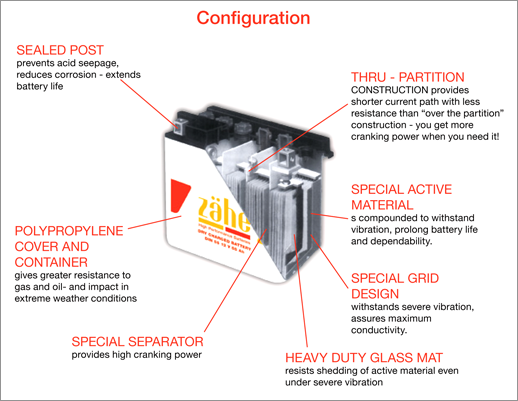
Special Grid Design
Severe vibration resistance & improved conductivity
Active Material
Proprietary Formulation
Reduced shedding, maximum utilization, & long service life
Pasted Plates
Specified Thickness & weight
Ensures vibration resistance through precise compression & proper Service life through specified active material balance
Dried-Charged Plates
Tank Formed & Dried Plates
Properly dried plates in a sealed battery have a virtually limitless shelf-life, while still retaining 70-80% state of charge when filled with acid
Top Lead Connections
Through-Partition-Construction, Large Straps
Shorter current path for increased electrical conductivity & higher starting currents, heavier parts for maximum durability
Case-Cover Seal
Thermal Bonded Plastic
Air tight seal to prevent air ingress & acid seepage
Terminal-Cover Seal
Patented Poly-Seal Terminal
Eliminates acid seepage, reduces corrosion, & extends battery life
Case & Cover
Polypropylene
Superior resistance to gasoline Soil, impact resistant in extreme weather conditions
Additive
Sulfate Stop(Some models)
Sulfate stop added to reduce the solubility of lead into the acid, which then reduces battery sulfation potential
Separator
Absorbed Glass Mat
Absorbs acid while creating cell compression for extreme vibration resistanc
Terminal Configuration
Type
Terminal (Front/Side/Top)
Battery Type
A
YTX4L-BS
YTX9-BS
YTX5L-BS
YTX12-BS
YT27S
KMX14-BS
YTX7A-BS
YTX14-BS
YTX7L-BS
YIX30L
B
YB3L-A
YB16-B-CX
12N5.5A-3B
YB5L-B
YB16L-B
6N6-3B
YB9A-A
12N5-3B
6N6-3B-1
YB12A-B
12N5-4B
6N11A-1B
YB14A-A1
12N5.5-3B
B49-6
C
HYB16A-AB
Y50-N18A-A
YB16B-A1
Y50-N18L-A
YB18-A
Y50-N18L-A-CX
YB18L-A
SY50-N18L-AT
D
YB10A-A2
YB14-A2
YB10L-A2
YB14A-A2
YB10L-B2
YB14L-A2
YB12AL-A2
SYB14L-A2
YB12B-B2
YB14-B2
E
YB14L-A1
YTX16-BS-1
YB7C-A
F
YB16AL-A2
G
Y60-N24AL-B
51814
Y60-N24A
51913
12N24-3
53030
12N24-3A
H
YHD-12
I
YT4B-BS
J
YT4B-BS
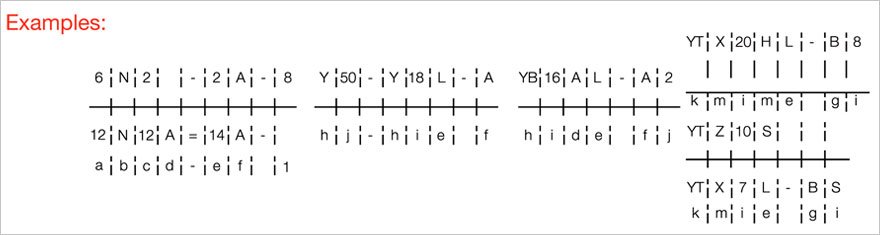
Designation of Battery Type Numbers
Designations:
Nominal voltage
Vented type (normal type)
Battery capacity at 10 hour rate
Indication of different size of the same capacity batteries
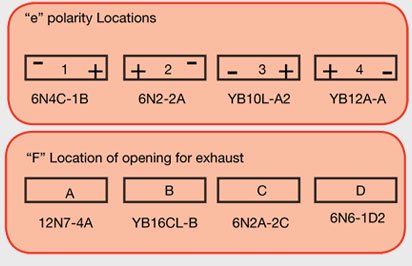
Polarity location (see Fig,1), configuration
Location of opening for exhaust (see Fig.2)
Type of terminal
Symbol of high performance batteries
Performance level
Cranking or starting power
Symbol of maintenance free (VRLA) batteries (YT. GT)